

The Healing Angel of Wound Management: The Science, Mathematics, and Manufacturing Economics of Povidone-Iodine

An In-Depth Guide for Pharmaceutical Manufacturers, R&D Scientists, and Clinical Formulators
In the multi-billion-dollar global wound care market, active pharmaceutical ingredients (APIs) rise and fall with the tides of medical trends. Yet, one compound has remained an unshakeable cornerstone of infection control, earning the moniker of the "Healing Angel" of wound management: Povidone-Iodine (PVP-I).
For B2B pharmaceutical manufacturers, producing high-efficacy antiseptic sprays, surgical scrubs, and first-aid ointments requires more than just mixing chemicals. It requires a profound understanding of pharmacokinetics, chemical equilibrium, thermodynamic stability, and clinical comparative efficacy.
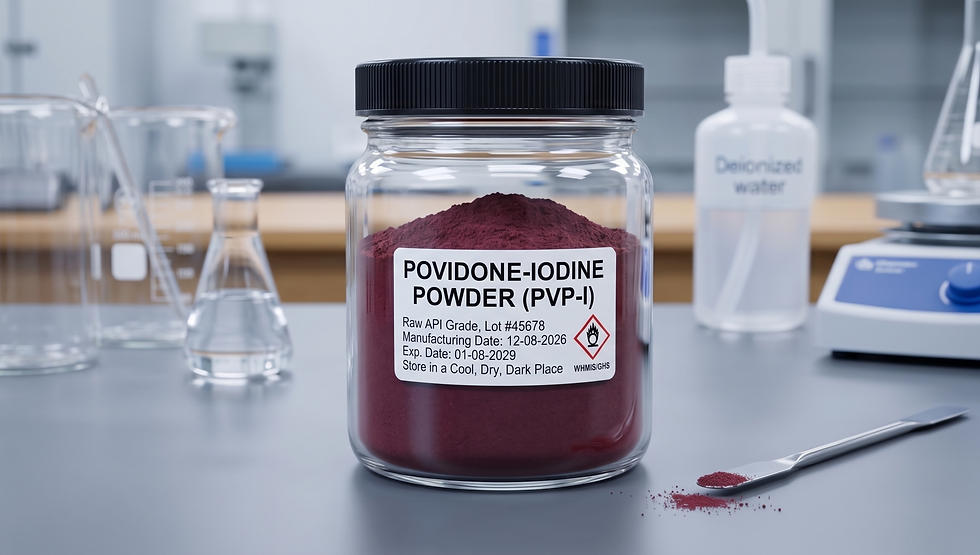
As a leading producer of premium Povidone-Iodine powder, Mireca International presents this comprehensive technical dossier. We will explore the mathematical models behind PVP-I’s microbicidal action, the paradoxical chemistry of its dilution, comparative clinical data, and the precise calculations required for commercial-scale pharmaceutical formulation.
1. The Historical Trajectory of Iodine in Medicine
To understand the modern dominance of PVP-I, we must look at how chemical engineering solved elemental iodine's earliest problems. Elemental iodine is a highly effective biocide but is practically insoluble in water and highly toxic to human tissue in its raw form.
Discovery of Elemental Iodine
1811
French chemist Bernard Courtois isolates iodine from seaweed ash. Within a decade, it is recognized for its potent antimicrobial properties.
Lugol's Solution
1829
Dr. Jean Lugol creates a water-soluble iodine solution using potassium iodide (KI). It becomes the standard for the American Civil War, though it remains highly irritating and causes severe tissue necrosis.
The Synthesis of PVP-I
1955
H.A. Shelanski and M.V. Shelanski discover that adding iodine to the synthetic polymer polyvinylpyrrolidone (PVP) creates an "iodophor." The polymer acts as a carrier, rendering the iodine water-soluble, stable, and virtually non-toxic to human cells.
Apollo 11 Mission
1969
NASA selects Povidone-Iodine to sterilize the Apollo 11 lunar module upon its return to Earth, cementing PVP-I as the gold standard for absolute biological eradication.
2. The Science of the "Healing Angel": A Multi-Target Assault
Povidone-Iodine is an iodophor—a complex of iodine with a solubilizing polymer agent. When complexed with iodine, it creates a highly unique and efficient delivery system.
Unlike modern antibiotics, which target specific cellular pathways (and thus inevitably lead to bacterial resistance), free molecular iodine operates via a rapid, multi-faceted attack on pathogens. It targets three specific areas simultaneously:
Proteins: Iodine oxidizes specific amino acids, permanently denaturing the essential cellular enzymes that bacteria need to survive.
Nucleic Acids: It reacts with the nitrogenous bases of DNA and RNA, completely halting viral and bacterial replication.
Cell Walls: Iodine attacks the carbon bonds in the fatty acids of bacterial lipid membranes, causing rapid cell lysis (destruction).
The Kill Rate Standard
In clinical efficacy testing, pharmaceutical manufacturers measure the potency of a PVP-I batch using logarithmic reduction benchmarks. In standard suspension tests against common pathogens like Staphylococcus aureus, a high-quality 10% PVP-I solution is expected to reduce a starting population of 1,000,000 viable bacteria down to just 10 survivors in 30 seconds.
This translates to a 99.999% kill rate in half a minute. It is a benchmark that PVP-I routinely achieves and that Mireca International's raw powder is explicitly optimized to deliver.
3. The Dilution Paradox: The Free Iodine Anomaly
For product formulators, the most critical physical property of PVP-I is the Dilution Paradox.
In almost all standard chemical solutions, diluting the mixture reduces the concentration and potency of the active agent. Povidone-Iodine behaves in the exact opposite manner.
PVP-I contains two types of iodine:
Available Iodine: The total amount of iodine locked inside the polymer complex (typically 9.0% to 12.0% of the raw powder by weight).
Free Iodine: The uncomplexed, active molecular iodine floating in the solution that actually does the microbicidal work. (Measured in parts per million, ppm).
In a concentrated 10% solution, the PVP polymer tightly binds the iodine. As water is added (dilution), the polymer network relaxes and swells. This structural shift actually releases more free iodine into the solution.
Data Representation: Free Iodine Concentration vs. PVP-I Solution Strength
The table below represents the bell-curve of free iodine release—crucial data for product development.
PVP-I Solution Concentration (%) | Total Available Iodine (ppm) | Active Free Iodine (ppm) | Clinical Application |
10.0% | 10,000 ppm | ~1 to 3 ppm | Standard stock, pre-op scrub |
5.0% | 5,000 ppm | ~10 ppm | First aid creams, ophthalmic prep |
1.0% | 1,000 ppm | ~15 ppm | Peak Antimicrobial Activity |
0.1% | 100 ppm | ~25 ppm | Maximum Free Iodine Peak |
0.01% | 10 ppm | ~1 ppm | Too dilute, rapid depletion |
The Formulation Takeaway: A 10% clinical solution acts as a chemical reservoir. It provides a steady, prolonged release of a small, non-toxic amount of free iodine. When a patient applies it to a wound, the natural wound exudate (fluids) dilutes the 10% solution. This triggers the polymer to release a sudden spike of free iodine precisely when and where it is needed most, wiping out bacteria without harming the human tissue trying to heal the wound.
4. Clinical Efficacy: PVP-I vs. Cadexomer Iodine
When sourcing active ingredients for wound care, B2B buyers often compare different iodine delivery mechanisms. A recent and comprehensive comparative review in surgical dermatology isolated the specific use-cases for PVP-I versus Cadexomer Iodine.
Cadexomer Iodine: This formulation consists of iodine immobilized in microbeads of dextrin.
The Clinical Profile: One gram of cadexomer iodine can absorb up to 7 milliliters of wound fluid. Because it is highly absorptive, it is explicitly prescribed for chronic, highly exudative wounds (such as diabetic foot ulcers and venous leg ulcers) where heavy fluid drainage is the primary concern.
Povidone-Iodine (PVP-I):
The Clinical Profile: Animal and human in-vivo studies demonstrate that PVP-I achieves a staggering reduction in bacterial load within the first 10 minutes of a single application.
The Application: PVP-I is the undisputed "healing angel" for acute wounds, minor burns, traumatic skin loss, and active infections. It rapidly eradicates bacteria without the negative impacts on wound healing associated with harsher antiseptics.
Comparative Cytotoxicity (Cell Survival)
Harsh chemicals erode healthy cells, actively slowing the healing process. When testing the minimum concentration that causes cell death in human fibroblasts, the safety profile heavily favors PVP-I over traditional, older options.
Antiseptic Agent | Microbicidal Efficacy | Fibroblast Cytotoxicity | Impact on Wound Healing |
Povidone-Iodine | Very High (Broad Spectrum) | Low (Safe at therapeutic levels) | Neutral to Positive |
Hydrogen Peroxide (3%) | Moderate | Very High | Negative (Delays tissue repair) |
Isopropyl Alcohol (70%) | High (Bacteria only) | Extremely High | Severely Negative (Tissue necrosis) |
Chlorhexidine (0.12%) | High | Moderate | Neutral |
5. Industrial Pharmaceutical Manufacturing: Scale and Stability
For production managers and procurement officers, the quality of the raw PVP-I powder directly impacts commercial yields and the bottom line. Mireca International produces PVP-I powder that optimizes large-scale consistency.
Achieving Maximum Batch Yields
When producing a massive commercial batch—such as a 5,000-liter vat of 10% topical solution—manufacturers must account for the purity and moisture content of their raw materials.
Subpar iodine powders often have a high "loss on drying" metric, meaning manufacturers are essentially paying for trapped moisture. By utilizing premium powder with guaranteed high purity (95%+ active complex), production facilities can scale their recipes linearly without complex, wasteful adjustments to compensate for degraded or damp raw materials.
Shelf-Life Stability
Stability is a primary concern for over-the-counter (OTC) pharmaceutical buyers. Iodine can easily sublimate (turn into a gas) or degrade if the polymer binding is weak.
Because Mireca uses high-molecular-weight polyvinylpyrrolidone, the energy required to break the polymer-iodine bond is exceptionally high. This thermodynamic stability guarantees a standard shelf-life of 24 to 36 months for final formulations stored at room temperature. This dramatically reduces product recall risks and expired inventory costs for retail pharma brands.
6. Formulating for Success: Best Practices
For R&D teams building new product lines, incorporating PVP-I requires precise procedural steps to maintain chemical equilibrium and ensure product viability.
1.Solvent Preparation:
Water Quality is Paramount.
Begin with Purified Water (USP grade). Heat the water to approximately 30 to 40 degrees Celsius. Do not exceed 50 degrees Celsius, as high temperatures will cause the iodine to sublimate and escape as a purple gas, ruining the batch yield.
2.Powder Dispersion:
Prevent Clumping.
Using a high-shear mixer, slowly sift the Mireca International PVP-I powder into the vortex of the water. PVP-I is hygroscopic and will form insoluble "fish eyes" (clumps) if dumped rapidly.
3.pH Adjustment:
Monitor the pH. A standard 10% PVP-I solution naturally rests between pH 1.5 and 5.0. Depending on the final application (e.g., ophthalmic drops vs. topical first aid), buffer the solution using sodium hydroxide or citric acid buffers to the required specification.
4.Excipient Addition:
Surfactants and Emollients.
For surgical scrubs, add the appropriate non-ionic surfactants. Avoid cationic surfactants, as they will aggressively disrupt the polymer-iodine complex and neutralize the antimicrobial efficacy.
7. The B2B Market Economics
The global antiseptics and disinfectants market is currently valued at over $24 Billion USD, with a projected Compound Annual Growth Rate (CAGR) of 6.7% through the end of the decade.
Within this sector, Iodophors (specifically PVP-I) account for a dominant market share in the pre-operative skin preparation and OTC wound care segments. The rise in surgical procedures globally, combined with an aging population susceptible to acute wounds, guarantees sustained demand.
However, the supply chain for high-grade iodine is notoriously volatile. Manufacturers who rely on inconsistent suppliers face fluctuating available-iodine levels, which leads to failed Quality Assurance tests and rejected batches.
8. Why Mireca International is Your Strategic Partner
As the B2B landscape becomes more competitive, pharmaceutical brands cannot afford raw materials that fail specification limits. Mireca International produces Povidone-Iodine powder specifically engineered to solve the pain points of commercial manufacturing:
Guaranteed Available Iodine: Our synthesis process ensures a tightly controlled available iodine content (9.0% to 12.0%), ensuring your final product easily passes pharmacopeia (USP/EP/BP) titrations.
Optimized Particle Size: We mill our powder to an optimal micron size to prevent clumping during high-shear mixing, drastically reducing your batch processing time.
Low Moisture Content: By keeping our loss-on-drying metrics well below the industry standard, you pay for active API, not water weight.
Supply Chain Stability: We offer reliable, scalable tonnage for global distribution, insulating your production line from regional iodine shortages.
The Ultimate Active Ingredient
From the battlefields of history to the sterile environments of modern surgery, Povidone-Iodine has proven itself as the ultimate healing angel. By understanding the deep science, the chemical mechanics, and the formulation requirements, your pharmaceutical brand can leverage this powerful molecule to dominate the wound care market.
To produce the best antiseptics, you must start with the best powder.


Comments