

Povidone Iodine: Complete Guide for Pharmaceutical Manufacturers

A Technical and Procurement Guide to PVP-I Specifications, Applications, Quality Control, Formulation Development and Bulk Sourcing

Povidone Iodine (PVP-I) is one of the most established iodine-based antiseptic ingredients used in pharmaceutical and healthcare manufacturing. From surgical skin preparation and wound-care products to topical antiseptic solutions and specialized medical formulations, PVP-I plays an important role in infection prevention and product development.
For pharmaceutical manufacturers, however, sourcing Povidone Iodine involves more than identifying a chemical ingredient.
The quality of PVP-I raw material can influence formulation stability, available iodine content, product consistency, regulatory compliance and manufacturing performance. Selecting a suitable supplier therefore requires careful assessment of chemical specifications, quality documentation, production capabilities and supply reliability.
This guide explains the science behind Povidone Iodine, its pharmaceutical applications, quality parameters, formulation considerations and the essential questions manufacturers should ask before purchasing it in bulk.
It also addresses international procurement considerations for pharmaceutical companies, chemical importers and distributors in Indonesia and Malaysia sourcing Povidone Iodine from India.
What Is Povidone Iodine (PVP-I)?
Povidone Iodine is an iodophor complex formed by combining iodine with povidone, a water-soluble polymer also known as polyvinylpyrrolidone (PVP).
The polymer acts as a carrier and reservoir for iodine, enabling controlled release of antimicrobial iodine species in an aqueous formulation.
Unlike elemental iodine used alone, PVP-I provides a practical method of incorporating iodine into many antiseptic preparations.
Key Product Information
Property | Information |
Chemical name | Povidone Iodine |
Common abbreviation | PVP-I |
Alternative name | Polyvinylpyrrolidone Iodine |
CAS number | 25655-41-8 |
Chemical category | Iodophor / Antiseptic ingredient |
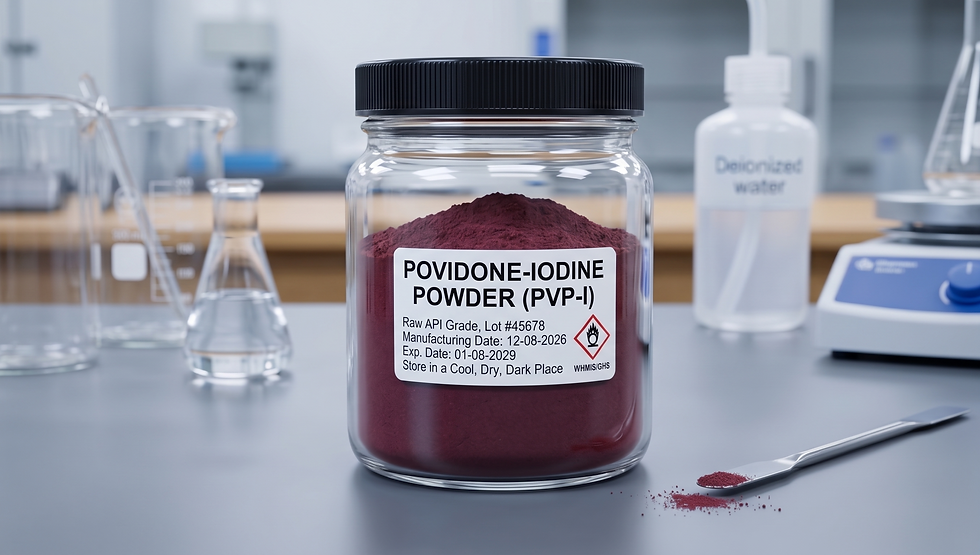
Typical appearance | Reddish-brown to brown powder |
USP available iodine specification | 9.0–12.0% on dried basis |
Primary applications | Pharmaceutical and healthcare antiseptic formulations |
Common commercial form | Bulk PVP-I powder |
Quality documentation | COA, SDS and applicable technical specifications |
The USP available iodine range refers to the raw Povidone Iodine material, not the percentage of PVP-I in a finished antiseptic solution.
This distinction is particularly important for formulation scientists and procurement teams evaluating different grades of raw material.
How Does Povidone Iodine Work?
The antimicrobial action of Povidone Iodine depends on iodine species released from the povidone-iodine complex.
When PVP-I is introduced into an appropriate aqueous environment, a dynamic equilibrium develops between iodine associated with the polymer and iodine available in solution.
As free iodine interacts with microorganisms, additional iodine can be released from the complex.
The Antimicrobial Mechanism
Iodine acts on several essential components of microbial cells.
These include proteins, enzymes, membrane structures and nucleic acids.
Through oxidative reactions and disruption of vital cellular processes, iodine can damage microorganisms and interfere with their survival.
Povidone Iodine has demonstrated broad antimicrobial activity against many bacteria, fungi and viruses under suitable test conditions.
However, the performance of a finished product depends on its formulation, concentration, contact time, organic contamination and intended application.
Manufacturers should therefore distinguish between the known antimicrobial properties of PVP-I and the validated performance of their specific finished formulation.
Why the Povidone Carrier Matters
The povidone polymer contributes several important functional characteristics:
It helps solubilize and carry iodine.
It serves as a reservoir from which iodine can be released.
It supports the development of practical aqueous antiseptic preparations.
It influences iodine availability and formulation behavior.
It provides a different handling and formulation profile from elemental iodine alone.
The polymer itself is not the primary antimicrobial agent. Its importance lies in supporting the delivery of active iodine.
For pharmaceutical manufacturers, understanding this relationship is essential when evaluating formulation performance and product stability.
Why Povidone Iodine Is Important in Pharmaceutical Manufacturing
PVP-I remains relevant because it combines established antiseptic activity with flexibility across several dosage forms and applications.
Manufacturers can develop different products using appropriately specified Povidone Iodine raw material.
These include topical solutions, surgical preparation products, antiseptic scrubs, wound-care formulations and certain specialized medical preparations.
Nevertheless, the raw material must be compatible with the intended formulation and the applicable regulatory requirements.
A supplier's statement that a material is pharmaceutical grade should never replace formal supplier qualification, analytical testing or review of the relevant pharmacopoeial specifications.
Five Manufacturing Considerations
Raw-material consistency: Batch variation can affect downstream formulation performance.
Available iodine: The amount of chemically available iodine is a critical quality attribute.
Formulation stability: Product behavior can change with pH, excipients, temperature and storage conditions.
Documentation: Manufacturers need traceable specifications, analytical methods and batch records.
Supply continuity: Reliable procurement helps prevent production interruptions and repeated supplier qualification exercises.
These considerations make PVP-I sourcing a technical and commercial decision rather than a simple commodity purchase.
Major Pharmaceutical Applications of Povidone Iodine
1. Surgical Skin Preparation
Povidone Iodine is widely used in antiseptic preparations intended for preoperative skin preparation.
Such products are designed to reduce microorganisms on the skin before selected medical procedures.
Commercial formulations may differ in PVP-I concentration, excipients, delivery method and instructions for use.
Manufacturers must validate the intended antiseptic performance and ensure the finished product complies with the applicable regulatory requirements.
2. Wound-Care Products
PVP-I is incorporated into certain antiseptic wound-care products, including topical solutions and other suitable formulations.
The purpose is to provide antimicrobial activity in an appropriately designed product.
However, wound-care suitability depends on the wound type, concentration, exposure duration and product labeling.
Manufacturers should not assume that every PVP-I preparation is suitable for every wound.
3. Skin Antiseptic Formulations
Povidone Iodine is used in products intended for topical antisepsis.
These may include solutions and other dosage forms developed for professional or consumer healthcare markets.
Important formulation considerations include skin compatibility, available iodine, product stability and packaging compatibility.
4. Pharmaceutical Antiseptic Solutions
Liquid antiseptic formulations are among the best-known applications of PVP-I.
Aqueous Povidone Iodine solutions can be designed for specific approved applications.
Manufacturers must evaluate the relationship between raw-material concentration, available iodine and the final product's performance.
5. Healthcare and Medical Products
PVP-I may be incorporated into certain healthcare preparations where iodine-based antiseptic activity is appropriate.
Applications should be supported by product-specific evidence and suitable regulatory authorization.
6. Specialized Pharmaceutical Formulations
Certain ophthalmic and other specialized formulations use carefully controlled Povidone Iodine concentrations.
These products require additional formulation controls, safety evaluation and route-specific quality requirements.
Ordinary topical PVP-I raw material or solution must not automatically be considered suitable for ophthalmic, oral or mucosal applications.
Specialized formulations require appropriate development, validation and regulatory review.
Understanding Povidone Iodine Specifications
One of the most important responsibilities of a pharmaceutical procurement team is verifying that incoming raw material meets the approved specification.
For PVP-I, several analytical and physical characteristics deserve particular attention.
Available Iodine Content
Available iodine is a key quality parameter used to characterize Povidone Iodine.
The USP monograph specifies 9.0% to 12.0% available iodine, calculated on the dried basis, for Povidone Iodine raw material.
Manufacturers should review the applicable monograph and current supplier COA rather than relying solely on a general product description.
Available iodine is not identical to free iodine concentration in a finished solution.
Free iodine concentration is influenced by formulation chemistry and equilibrium behavior.
Moisture and Loss on Drying
Moisture-related characteristics can influence raw-material handling, storage and specification compliance.
Manufacturers should evaluate the applicable loss-on-drying limit, analytical method and actual batch result.
Identification
Identification testing helps establish that the received material corresponds to the intended Povidone Iodine ingredient.
The relevant pharmacopoeial method or validated internal method should be followed.
Impurities and Related Quality Parameters
Depending on the applicable standard and product specification, additional testing may be necessary.
This can include iodide-related parameters, residual impurities and other specified quality attributes.
The required testing program should be based on the current applicable monograph, regulatory requirements and documented risk assessment.
Physical Appearance
Povidone Iodine raw material commonly appears as a reddish-brown or brown powder.
Visual appearance can provide useful preliminary information but cannot replace analytical testing.
A batch should not be approved solely because its color or texture resembles previously accepted material.
Povidone Iodine USP, BP and Ph. Eur.: What Manufacturers Should Know
Pharmaceutical manufacturers frequently encounter references to USP, BP, EP or Ph. Eur. grades when evaluating Povidone Iodine suppliers.
These abbreviations refer to pharmacopoeial standards and associated quality requirements.
USP refers to the United States Pharmacopeia.
BP refers to the British Pharmacopoeia.
Ph. Eur. refers to the European Pharmacopoeia.
Different markets may require compliance with particular standards or recognize specific pharmacopoeial references.
Although the standards can share similar analytical objectives, manufacturers should not assume their requirements are identical.
How to Evaluate a Claimed Pharmacopoeial Grade
Before approving a supplier, request confirmation of:
The applicable pharmacopoeial standard and edition.
The approved raw-material specification.
The batch Certificate of Analysis.
Analytical methods used for release testing.
Any relevant deviations or additional customer-specific tests.
Documentation supporting the claimed grade.
A statement such as "USP/BP/EP grade" should be supported by actual specifications and testing records.
Where more than one standard applies, the quality team should verify compliance with each required monograph.
Povidone Iodine Powder vs Povidone Iodine Solution
One of the most common procurement misunderstandings involves confusing bulk PVP-I powder with a finished Povidone Iodine solution.
These are not interchangeable commercial products.
Povidone Iodine Powder
Bulk PVP-I powder is a raw material used by manufacturers to develop finished formulations.
It requires appropriate processing, quality control and formulation development.
Buyers generally evaluate its available iodine content, raw-material specification, documentation, packaging and suitability for manufacturing.
Povidone Iodine Solution
A Povidone Iodine solution is a formulated product containing PVP-I and other ingredients as appropriate.
The finished formulation may require additional testing for stability, antimicrobial performance, packaging compatibility and regulatory compliance.
Understanding a 10% PVP-I Solution
A commonly referenced 10% Povidone Iodine solution contains approximately 1% available iodine when based on PVP-I material containing approximately 10% available iodine.
This is a useful conceptual relationship, not a substitute for finished-product assay.
Actual results depend on raw-material assay, formulation, processing and testing.
Manufacturers should therefore calculate their formulation requirements using the approved raw-material specification and confirm the finished product through validated analytical methods.
Formulation Development: Critical Factors to Evaluate
Developing a stable PVP-I product requires an understanding of iodine chemistry and the behavior of the selected excipients.
pH and Chemical Stability
Povidone Iodine formulations are sensitive to their chemical environment.
Iodine availability and stability can be affected by pH, particularly under alkaline conditions.
The appropriate pH range must be established through formulation development and stability studies rather than assumed from a generic recipe.
Excipient Compatibility
Excipients may interact with iodine or influence its availability.
Formulators should evaluate the compatibility of solvents, surfactants, thickeners, stabilizers and other ingredients.
Any material that reacts with iodine or changes the formulation environment may affect the finished product.
Packaging Compatibility
Container and closure selection can influence product stability.
Manufacturers should assess potential interactions between iodine-containing formulations and packaging materials.
Container-closure integrity, light exposure and storage conditions should also be considered.
Stability Testing
A finished PVP-I formulation requires a stability program appropriate to its regulatory classification and intended market.
Testing may include appearance, assay, available iodine, pH, microbiological attributes where applicable, and other product-specific quality characteristics.
The shelf life should be supported by stability evidence.
Manufacturing Process Validation
Manufacturers should establish controlled processing conditions and appropriate in-process checks.
The manufacturing process must consistently produce material meeting the approved finished-product specification.
This requires documented procedures, equipment qualification where applicable, and an appropriate quality management system.
Quality Control: How to Evaluate a Povidone Iodine COA
A Certificate of Analysis is one of the most important documents in pharmaceutical raw-material procurement.
It provides batch-specific analytical information and allows the buyer to compare the supplied material against an agreed specification.
A useful PVP-I COA should identify the material, batch and relevant test results.
Essential COA Review Points
Product identity: Confirm the product name and identifying information.
Batch number: Ensure the documentation corresponds to the actual shipment.
Specification: Review the limits against the applicable approved standard.
Available iodine: Confirm the reported result and testing basis.
Additional tests: Evaluate the required identification, moisture and other quality attributes.
Test methods: Check whether the stated methods are appropriate and validated or compendial as required.
Release authorization: Confirm that the documentation has been reviewed and approved by the responsible quality function.
Traceability: Verify that the batch information is consistent across labels, shipment documents and supplier records.
A COA is important, but it is only one part of supplier qualification.
Manufacturers may also need quality agreements, supplier audits, incoming-material testing and ongoing performance monitoring.
How to Choose a Reliable Povidone Iodine Supplier
Selecting a PVP-I supplier should involve both technical qualification and commercial assessment.
The lowest quoted price does not necessarily represent the lowest procurement risk.
A reliable supplier should be able to communicate clearly about the material being supplied and provide appropriate supporting documentation.
1. Verify the Business Model
Determine whether the company is the actual manufacturer, a contract-manufacturing partner, an exporter or a distributor.
These are legitimate but different business models.
The supplier should accurately disclose its role and the origin of the material.
2. Evaluate Quality Documentation
Request the applicable COA, SDS, specifications and relevant quality information.
Do not assume that a marketing claim establishes pharmacopoeial compliance.
3. Confirm Commercial Quantities
Discuss the minimum order quantity, available packaging and expected recurring volume.
The supplier should understand whether the requirement is for development, qualification or commercial production.
4. Assess Supply Continuity
Ask about lead times, production or sourcing capacity, batch availability and contingency arrangements.
For recurring pharmaceutical manufacturing, consistency of supply can be commercially critical.
5. Review Export Capabilities
International procurement requires accurate shipping documents, packaging information and clear commercial terms.
The responsibilities of the buyer and seller should be established before shipment.
6. Evaluate Technical Communication
A supplier should be able to respond meaningfully to specification questions.
Clear technical communication is especially valuable during qualification and formulation development.
Povidone Iodine Sourcing for Indonesia
Indonesia is an important market for pharmaceutical ingredients and healthcare manufacturing.
Companies sourcing Povidone Iodine from India should evaluate both the technical suitability of the raw material and the requirements of cross-border procurement.
What Indonesian Buyers Should Consider
Indonesian manufacturers and importers should confirm the applicable import classification, documentation and regulatory requirements before ordering.
Depending on the product's intended use and regulatory status, relevant Indonesian authorities and local import procedures may need to be consulted.
Important procurement questions include:
Is the material intended for pharmaceutical manufacturing?
Which pharmacopoeial specification is required?
What commercial quantity is needed?
What documentation is required for import and quality approval?
Which Indonesian destination will receive the shipment?
What are the expected delivery and customs-clearance arrangements?
Buyers should also consider supplier qualification and the economics of importing from India compared with alternative sources.
Looking for a Povidone Iodine supplier for Indonesia?
Mireca International welcomes enquiries from Indonesian pharmaceutical manufacturers, importers and distributors evaluating bulk PVP-I sourcing from India.
Povidone Iodine Sourcing for Malaysia
Malaysia is another strategic market for pharmaceutical raw-material procurement.
Manufacturers and distributors evaluating PVP-I imports should consider specification compliance, documentation, supply reliability and local regulatory requirements.
Procurement Considerations for Malaysian Buyers
Before purchasing Povidone Iodine, buyers should establish:
The intended pharmaceutical or healthcare application.
The applicable material specification.
Required quality and technical documentation.
Supplier qualification requirements.
Commercial order quantity.
Import and customs documentation.
Destination and delivery requirements.
Long-term supply expectations.
Importers should verify the relevant requirements with the appropriate Malaysian authorities and their regulatory or customs specialists.
Pharmaceutical manufacturers should also ensure that incoming raw materials satisfy their approved quality systems.
Need bulk Povidone Iodine for Malaysia?
Mireca International accepts enquiries from Malaysian manufacturers, chemical distributors and procurement teams seeking an India-based PVP-I supply source.
What Determines the Bulk Price of Povidone Iodine?
Bulk Povidone Iodine pricing depends on several commercial and technical variables.
These include material specifications, quality requirements, order quantity, packaging, supply conditions and international logistics.
Product Specification
Different quality requirements can affect production, testing and documentation costs.
Order Quantity
Commercial volumes can influence the unit price, although the relationship varies by supplier and transaction.
Packaging
Packaging configuration affects handling, storage, shipping and sometimes product protection.
Documentation Requirements
Additional testing, qualification or customer-specific documentation can influence the total procurement cost.
Freight and Delivery Terms
International quotations may differ depending on the agreed Incoterms, shipping route, insurance and destination.
Supply Conditions
Availability, production schedules and commercial terms can also influence quotations.
For meaningful price comparisons, buyers should request quotations against the same specification, quantity, packaging and delivery basis.
A low unit price is not necessarily a lower landed cost.
Requesting a Povidone Iodine Sample or Bulk Quotation
A well-prepared enquiry helps suppliers respond more accurately and reduces unnecessary communication.
Pharmaceutical buyers should ideally provide the following information:
Procurement detail | Information to provide |
Product | Povidone Iodine (PVP-I) |
CAS number | 25655-41-8 |
Grade | Required pharmacopoeial or customer specification |
Quantity | Sample, trial batch or commercial requirement |
Application | Intended manufacturing or formulation use |
Documentation | COA, SDS and other required records |
Destination | Country, city or port |
Delivery terms | Preferred Incoterms, if known |
Timeline | Required delivery period |
Recurring demand | Estimated monthly or annual quantity |
This information allows a supplier to assess both technical suitability and commercial feasibility.
Frequently Asked Questions
Is Povidone Iodine the same as iodine?
No. Povidone Iodine is a complex of iodine with the polymer povidone. The polymer acts as a carrier and reservoir, allowing iodine to be released in suitable formulations.
What is the CAS number of Povidone Iodine?
The CAS number commonly used for Povidone Iodine is 25655-41-8.
What is the available iodine content of PVP-I powder?
The USP monograph for Povidone Iodine specifies 9.0–12.0% available iodine on the dried basis. Buyers should verify the applicable specification and actual batch COA.
Is Povidone Iodine powder the same as a 10% PVP-I solution?
No. PVP-I powder is a raw material, while a 10% PVP-I solution is a finished or intermediate formulation containing a defined concentration of the complex.
Can Povidone Iodine be used in wound-care products?
Yes, PVP-I is used in certain antiseptic wound-care formulations. Suitability depends on the specific product, wound type, formulation and approved instructions for use.
What documents should pharmaceutical buyers request?
Common documents include the Certificate of Analysis, Safety Data Sheet, technical specifications and other relevant quality records. Additional documentation may be required depending on the destination market and intended use.
What is the difference between USP and BP Povidone Iodine?
USP and BP refer to different pharmacopoeial standards. Manufacturers should compare the current applicable monographs and verify compliance through appropriate specifications and test results.
Can pharmaceutical manufacturers import Povidone Iodine from India?
International procurement may be possible subject to the supplier's capabilities, applicable export controls, destination-country import requirements and the buyer's regulatory obligations.
How should Povidone Iodine be stored?
Storage should follow the applicable approved specification, SDS and supplier instructions. Appropriate containers and protection from unsuitable environmental conditions are important for maintaining material quality.
How can manufacturers request a bulk PVP-I quotation?
Provide the required grade, specification, quantity, application, destination, documentation requirements and delivery timeline to the supplier.
Conclusion: Building a Reliable Povidone Iodine Supply Chain
Povidone Iodine remains an important raw material for pharmaceutical and healthcare antiseptic manufacturing.
Its value extends beyond antimicrobial activity. Successful commercial use depends on raw-material quality, formulation compatibility, validated manufacturing processes, regulatory compliance and reliable supply.
For procurement teams, the most important decision is not simply identifying a company offering PVP-I at a competitive price.
It is selecting a supplier capable of meeting the organization's technical, quality and commercial requirements consistently.
Manufacturers should evaluate available iodine specifications, batch documentation, supplier traceability, packaging, supply continuity and the regulatory requirements of their intended market.
For businesses in Indonesia and Malaysia, these considerations become particularly important when evaluating international supply partners.
Source Povidone Iodine from Mireca International
Mireca International is an India-based specialty chemical supplier supporting commercial Povidone Iodine sourcing enquiries from pharmaceutical manufacturers, importers and distributors.
If your organization is evaluating PVP-I for manufacturing, formulation development or recurring bulk procurement, contact our team to discuss your requirements.
Request a Povidone Iodine Bulk Quote
Ask for COA and Technical Specifications
Discuss Supply Requirements for Indonesia or Malaysia
Contact Mireca International This article is intended for pharmaceutical industry information and procurement education. Product specifications, regulatory status, formulation suitability and clinical use must be verified against applicable current standards and product-specific evidence.


Comments